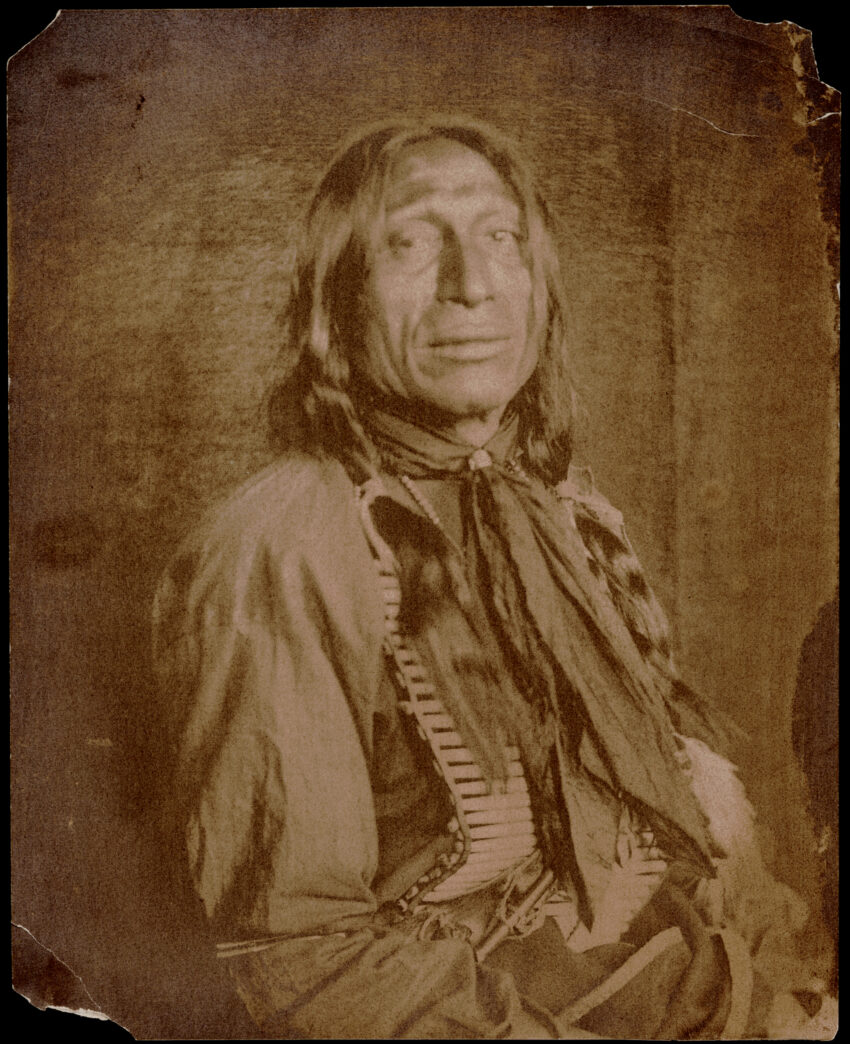
Words: Merlin Betts. Img: Iron Tail portrait, sitting for Gertrude Käsebier (public domain).
This all started about a year ago with me trying to understand why Hastings Museum have a – pretty damn splendid – Native American headdress, and whether they should hold onto it or not.
That story was supposed to be a quick bit of light entertainment I could write up in an afternoon. Instead, it’s taken hours and then days and now possibly weeks of research – and I know I’m still not there. But I’ve searched and I’ve scribbled and now you need to see some of what I’ve been working on. Well, I need someone to see it, before I lose my goddang sanity.
I want to tell you about Iron Tail, or Siŋté Máza, a Lakota chief who grew up in one of the most remembered moments of American invader-versus-native history – a period that was in many ways the American indigenous peoples’ most apocalyptic, if not final chapter.
We have (what might be) one of his headdresses, a war bonnet, sat in Hastings Museum. And next to that bonnet is almost no information about its supposed former owner. Instead, there’s a load of information about some bloke called Archibald Belaney, a man who spent much of his life masquerading as an American Indian (terminology of the time). And this don’t feel right.
I mean sure, Archie is from Hastings and he lived a very interesting existence. More of a grand schoolboy adventure than a life. He should be featured as the strange creature he is, don’t get me wrong, but what about the real natives? Specifically the one who supposedly inspired little Archie by leading a procession down the seafront. What about their story – how their artefacts ended up here all the way across the sea?
I suppose, to be fair to Hastings Museum (at least as far as the headdress) there doesn’t seem to be much concrete information about Iron Tail out there. Between partially constructed accounts and fluff pieces in the popular press, some joining of dots is required, and that’s not ideal if you want unimpeachable evidence and a rock-solid story that even the Victorians couldn’t explode (this was supposed to follow a piece about John’s Place that mentions the White Rock – which doesn’t exist because the Victorians blew it up).
On the other hand, there’s a wealth of information about the Lakota more broadly, and there’s the modern day Lakota, Dakota, Nakota Nation – the people that colonisers took to calling the Sioux. And that’s a title the French adopted from the Sioux’s enemies which means something like “snake” or “bad” or just “enemy”. But over the years even some of the Sioux started referring to themselves as Sioux. That’s the price of getting colonised – you start to forget your own story, or stop caring.
Possibly they were all Dakota to begin with (and the only differences were just accents on the same words) but I’m getting distracted. Point is, if you bring in their story, there’s almost too much information to communicate, at least as far as a sidelined museum exhibit of questionable provenance.
But their story is exactly what we should be expressing, rather than the arms-length history of the Americas provided by missionaries (the Callendars), society dilettantes (Clare Sheridan) and collectors of curios (Brasseys and to some extent Colin Taylor). After all, what’s the point in gathering these strange artefacts if not to explore some weird alternative way of existing as a civilization? It could be the historical materialist in me, but I thought that’s what study – and indeed exhibition – of the past is all about. (It’s dialectics, man!)
We can only really infer from what was happening around Iron Tail what his earlier life might’ve been like. Most of the on-record material we have about him comes from his time as a chief and a performer in Buffalo Bill’s Wild West – and yes, that show is the reason why we talk about “the Wild West” as a thing. But by the time he’s doing that, we don’t actually know how old he is, or what his background was before becoming leader of a people stuck on the reservation.
That hasn’t stopped me though. And it shouldn’t have stopped Hastings Museum from at least trying. A bit. Talking to hobbyists and voluntary organisations. Listening to the Rest Is History’s eleven part podcast on the period (which I would recommend, episodes 446-456).
As I understand it, the Museum’s bigger reason for not trying is a lack of resources. And that is fair enough. I mean, how could they possibly spend staff time looking into some old Indian guy when what they should be doing is cleaning the single VHS tape that contains the Life and Times of Archibald Belaney, recorded over a 1979 reissue of the black and white film Custer’s Last Stand?
I wrote that jibe about a year ago, and this is only coming out now. Who’s really the fool here? Well, I’ve done enough research to make the entire Grey Owl room about Iron Tail instead. That’s not so abysmally bad for a kid workin’ in his spare time.
If my jibe’s too obscure, by the way, then you should know that in the permanent Grey Owl exhibition at Hastings Museum there’s a TV set with an old documentary about the guy playing on loop. It might not be VHS, but it reminds me of growing up in the 90s. And that’s what I was referring to.
I’m trying to be a lot more careful in this study to maintain some kind of respect and depth to my investigation, because I now think my last article about Iron Tail and Hooso Tacaam was a bit of an ugly mess. Yeah, I’m – in part – hoping make amends for writing that by writing this.
But also because researching what happened to the Lakota has made me reflect on the kind of thing that happened to my pagan ancestors, whether they be the Celtic Britons I associate myself with, the pre-Christian Roman survivors, the invading Germanic and Viking pagans who adopted this land as their own, or anyone else. It was all eaten up by European Christianity, imperial-style. And, more or less, that’s just what happened to the Lakota too. The “superior white race” as many Americans spoke of themselves at the time, is full of love-thy-neighbour Christians keen on missionary work. Jesus was brown, of course.
So, I can’t help but feel some respect for my comrades across the sea, trying to restart their cultural origins in the way that I, my father, and many Brits have tried to restart ours. It does mean this piece will be a bit more academic than I’d like though – apologies in advance, casual reader.
Let’s start at the beginning – what’s in a name?
Iron Tail was probably born in the 1850s, 1857 if you’re going to believe one particular census. But generally it’s not a good idea to rely on census material, as accurate details might not have been known or might’ve been deliberately misrepresented, after all – why would you want to tell your captors or your conquerors anything they could use against you?
Many years after Iron Tail’s birth (and in fact, his death), a sort of colleague and possible friend, Major Israel McCreight, related an origin for his name: that when he was a baby, his mother saw a hunting party chasing buffalo, the animals’ tails standing upright like hard metal sheets. This seemed unusual enough, and the resulting name unique enough, that she said “that’ll do”, and so he was named Iron Tail.
But I feel like this story is probably apocryphal, or at least a bad summary. Natives weren’t barbarians who named their children after random things that passed them by. Nature was invested with deep spiritual and symbolic significance to them, and the names referring to it shared that significance accordingly. I suspect this meaning tends to be more obvious in Lakota language (read a great article on this in the Lakota Times), and generally doesn’t fit quite so well in English, a language which comes from a completely different reference background.
So, were the hides of the buffalo particularly resistant to the hunters that day? Maybe. Is there plenty about both buffalo biology and their role in Lakota culture that I don’t know? Definitely.
I’ve been reading a lot on Celtic history too, and Celt mythology has much less of a sense of good versus evil, which also means they’re not strictly focussed on ‘good’ names and ‘bad’ names. You could name someone with a complicated set of references in mind – e.g. name them after a god who was both good and evil, or beautiful and sadistic, ugly and kind, maimed and capable – and not mean it as any kind of insult. Rather it’d be a mark of respect for the person – showing the potential of who they could become, and warning them not to be a dick as well.
Cunningham – aka, The British National Buffalo Bill Archive – has looked over what are probably the only two primary source documents that talk about Iron Tail in his youth. Assuming that this is the correct Iron Tail. Both are rather rudely titled, “The Sitting Bull Surrender Census”, 1881 and “The Crazy Horse Surrender Census,” 1877.
The Sitting Bull census mentions an Iron Tail whose dad, Little Hawk, is entered as “an Uncle of Crazy Horse” and indeed was mentioned in the Crazy Horse census. On its own this might not mean much, but I think it tells us a lot about the context Iron Tail was living in.
Lakota families raise children matrilineally, so Iron Tail might not have had anything to do with his dad and instead been raised by an uncle among his mother’s people. We can’t assume, as I initially did, that Little Hawk had a huge impact on who he became just because they’re father and son. Then again, I guess we also can’t assume he didn’t have an impact – blood wasn’t insignificant either.
The useful thing about this census and placement in history is just to tell us that Iron Tail was living in a uniquely tumultuous time, and was maybe travelling with the great Sitting Bull as he ran out of steam and increasingly risked starvation. Such things leave an impression on a young mind.
Lakota warrior culture and hidden decline
Since the plains tribes traditionally relied on hunting for much of their food, men would develop skills in horseback riding, tracking, tactical movement, and with various weapons including guns, as they continually hunted. All of these skills would be transferable to warrior roles, and all men (except those who voluntarily became women) would defend their families should the need arise. In fact, not just defend, but attack and claim various grisly trophies proving martial skill.
A quick note on the male/female divide. The Lakota generally assumed that men would do the hunting and fighting, and women would do the home-making, the cooking, cleaning, crafting. Men could choose to become women – resign any potential warrior prestige and do home-making instead. Women could still do grisly and violent stuff, following behind the frontline fighters to finish off and take trophies from fallen enemies. Inheritance also ran matrilineally.
So they’re not the most progressive society in our modern terms, but not the most sexist either. Everyone could do a bit of everything, and it seemed there was some attempt at a balance of power between genders, even if social pressure pushed them to follow traditional roles much of the time.
Anyway, since the men were pretty much all hunters, you could likewise say that all Lakota men were warriors, although some took to warfare and leadership more notably than others. For example, Crazy Horse and Sitting Bull – actually, fair chance you’ve heard of them. They were perhaps the most famous Lakota not to really integrate after their defeat, which probably helped to maintain their legend, unlike Red Cloud, Gall and others who increasingly gave in to European demands.
Oh, another quick note – I’m calling the US “Europeans” here because at the time they were substantially still white Europeans, and not so much their distant descendants. Colonel George Armstrong Custer (who we’ll be mentioning) had a bunch of Europeans who’d been fighting around Europe in his cavalry unit. Including an Italian bugler who could barely speak English. And he loved playing Irish tunes to boost morale and intimidate the Natives. (Col Kilgore anyone?)
There is a bigger narrative in play here. The US had been trying to displace and destabilize native populations for more than a century, and other Europeans had been doing the same before them. The campaign the US conducted over hundreds of years was almost like Vietnam, just stretched over a bigger period. Let me explain.
So the Sioux (among whom are the Lakota, Dakota and Nakota peoples) probably originate from Dakota culture – they would have been a forest-dwelling people who probably lived off the forests they resided in. There’s plenty of research to suggest that natives had deliberately cultivated these huge food forests (very nutritious fruit and nut trees, some hunting, some fishing) in the Americas before Europeans arrived. These forests were then steadily destroyed in order to deprive indigenous peoples of self-sustaining food. If you want to look into that (and I would recommend doing so), here’s a handy video essay.
The Vietnam comparison here is agent orange. And maybe forced collectivisation in the South.
The death of the forest and expansion of European settlements forced Natives to find new sources of food – like bison, which required hunting. The Lakota got horses from the Europeans (probably via the Cheyenne) and this enabled them to more fully develop the nomadic Plains hunting and warrior culture we know them for. The US responded by sponsoring the mass slaughter of buffalo (bison – called buffalo as a European affectation or genuine confusion) until that food source ran out too.
In the background to all this, Thomas Jefferson had pioneered a sneering imperialist attitude toward the Natives, telling them to see him and every US President as their Great Father – a term that many Natives seemed to adopt, even though the Europeans were really pernicious and childish invaders. In private communications Jefferson began plotting what would continue on through many administrations and many decades, to deprive the Natives of their land and maximise power and profit for the US.
By the time we meet the Lakota in the 1860s onward, they’re past caring that the colonisers have already destroyed at least one of their cultural identities. They have horses and guns and they’ve won an expansionist war against their neighbours, the Crow. They’d even just about won a war against the US by 1870. They’re fierce and angry and probably feeling quite confident about themselves.
Even though trains are running through the plains shooting bison and leaving them to rot (trains that are also bringing more settler-migrants to the land). Even though from 1867-1868 one William Fredrick Cody (later named Buffalo Bill after he won a bison-killing competition) slaughtered an estimated 4,282 bison to supply the Kansas Pacific Railroad.
In other words, even though the source of their food and their whole culture was quickly dying out, the Lakota probably felt pretty good about themselves. They weren’t stupid, they were just overconfident about their future prospects. Arguably they had to be – the alternative was to fall down and die.
Warrior Societies and Iron Tail the Bull Elk
Iron Tail was Oglala Lakota. That’s one of the seven council fires – social, religious and partly genetic groups, each with their own unique history. (I don’t think I’ve confused the Lakota seven with the Sioux seven, I think they may both use the seven council fires format.)
To dramatically oversimplify, maybe it’s a bit like being ‘Sussex English’ rather than just ‘English’, not that we’d ever say ‘Sussex English’. Also, given how decentralised power structures were in Lakota and broader Sioux (Očhéthi Šakówiŋ – Oceti Sakowin) society, it’s probably misleading to compare them with any modern European society. I don’t know enough about our ancient tribes to find a suitable comparison there either. Nomadic tribes are so informed by their geography as well, it’s probably misleading to compare them with anything short of another plains people. Anyway…
Warriors from the various nomadic Native peoples travelling the plains often formed societies for organising their hunting exploits and martial activities. These societies would be formed around archetypal and spiritual figureheads, symbols of which would be painted onto shields and carried into battle. They might also be represented in ‘vestments’ – various other themed adornments like body paint and trophies.
Historian Richard Green has analysed a shield that Iron Tail reportedly had in his possession, made of muslin, painted with artworks. Green says it’s likely he was part of an Oglala Elk Dreamer Society, and that would be illuminating if true.
The need for more functional fighting shields, made of tougher and heavier materials like rawhide, reduced over time – basically they weren’t very useful against guns, and after a while, everyone had guns. Some tribes may still have taken lighter shields into battle in later years, wearing them mainly because of their spiritual and cultural significance. Namely – the connection to their spirit archetype and warrior or dreamer community.
But by the 1880s, when warriors began to be recruited as performers, these lighter shields – like the muslin one linked to Iron Tail – became a regular feature of Wild West type shows. The extent to which they were theatrical replicas of heavy rawhide shields, or a continuation of a new lighter shield tradition is unclear.
Green’s provenance for the shield – a scout, artefact collector and performer named Hackett – claims Iron Tail made it “as duplicate to [the] original”. That wording arguably doesn’t tell us anything – it’s based on an original shield, but whose and what material?
Well, I think it’s fair to agree with Green and assume its Iron Tail’s own shield. If all Lakota men were required to be hunters and warriors fairly interchangeably, it’s likely they would all likewise go through some kind of coming-of-age warrior/dreamer society ritual, the precise details of which could probably be adapted a little between tribes and depending on conditions (having more or less food, time and resources). In other words, why wouldn’t Iron Tail join one? As far as I can tell, he very probably would join one.
And why would he otherwise manipulate his own past to change what entity he spiritually connected with? i.e. why would he wear a shield from a different society that he wasn’t part of? Answer: I don’t think he would.
Cunningham is cautious about the way Green confidently interprets the meaning of the shield’s artwork, and I also get a bit spooked when an academic uses phrases like “of course,” “clearly,” and “undoubtedly.” It just sounds like they’re trying to convince themselves as much as you. But I’m inclined to more or less accept his interpretation.
You can read the full details in Green’s article, but I want to focus on the implications this has for Iron Tail’s character. Quote incoming:
“The male elk was considered by the Sioux to have special powers over love and courtship. Elk Cult members observed the way in which a bull elk would fight to the death to protect its mate, and it was believed that such powers of ‘elk medicine’ [medicine = magic, more or less] were transferred to men who dreamt of this animal. Because of his powers over affairs of the heart, an Elk Dreamer was thought to be instrumental in matchmaking and the settling of marital disputes.”
I think this fits the narrative that we’re going to eventually reach in this article, that Iron Tail became a protector of his tribe, not so much a war chief, but a man capable of leading – and leading well enough – in peace. He will defend but not attack, he will settle disputes, he’ll try to bring about new futures. Maybe I’m drawing too much from too little material here, but I think this is perhaps how Iron Tail wanted to present himself, if nothing else. After all, it’s these symbols painted on the shield he wore.
The other feature of the shield is that it links to dreamer society vestments – paints and adornments worn so that society members could transcend the physical world and assume their animal’s “spirit principle”. While the shield is perhaps not fully transformative, it’s meant to be inspiring during battle, and so – I imagine – allow the warrior to disassociate a little from the task ahead of them, have their spirit guide take over. Lakota culture seems to involve a lot of this interesting psycho-spiritual manoeuvring, even without eating mushrooms or drinking deer piss, or whatever the Norse berserkers got up to.
In the same way, it could be inspiring to performers having to put up with American audiences, having to face that ignorance and the reality of being overwhelmed by a foreign, hostile culture. In that sense it might still be a ‘practical’ shield, protecting the user from the evil all around them.
It’s easy, I think, to assume that all performers were cynical, spiritually desolate, just getting by – and so probably not observing traditional practices. But I don’t think people always change or ‘adapt’ that quickly, and trauma doesn’t always make you break down, sometimes it makes you do the opposite: shore up your defences, entrench your beliefs.
The times, they are becoming quite different
If the 1881 census is correct, Iron Tail was 24 years old at the time of Sitting Bull’s surrender. Actually there’s probably not a huge amount of divergence from that even if the census is wrong, or if he’s a different Iron Tail – but we can discuss that in the comments if anyone’s keen. A cursory glance at Sitting Bull and Crazy Horse’s legends suggests young males could start tagging along with war bands not long after puberty. So let’s walk back 10 years from 1881.
An Oglala Lakota chief called Red Cloud had been leading his warriors in a war against US expansion from 1866-68, which was considered an overall win, but nonetheless ended with a treaty that put the Lakota on proto-reservations. So Sitting Bull refused to sign.
Instead his band kept raiding on-and-off into the 1870s. Some Lakota (not 100% sure of Sitting Bull’s movements, but some Lakota…) were raiding the railroads in this period, partly because the trains and the settlers on them were very obviously massacring bison and thereby diminishing the Plains food supply. Also in part because they were colonising land that had previously been Native or wild hunting ground.
The US sent soldiers, some under Custer, to defend the railroads. They met Lakota in combat in 1872, Custer was first engaged in 1873, and then in 1874 he ran an expedition to investigate the presence of gold in the Black Hills – pushing deeper into Lakota land. He assumed this was a viable chance at wealth and fame and didn’t really care whether that would force the Lakota out of the territory that had been declared unimpeachably their own just a few years before.
Law and treaty (and the lives of Native warriors and American soldiers) no longer mattered once that ‘worthless’ Native land suddenly started sprouting dollar signs from the very turf, in the form of hunks and chunks of shiny yellow metal. It actually never seemed to matter much – the law, the treaties. The Natives often laughed at the idea that you could draw lines on a map to decide who owns land, and the US basically laughed at the idea that they’d actually protect Natives from settlers. Neither side was much interested in upholding their agreements, but drew them up anyway. Diplomacy can also be part of military strategy.
Custer wasn’t attacked in 1874, but he erroneously reported huge amounts of gold in the Black Hills, causing a gold rush i.e. a huge migration of desperate settlers into Lakota land. In 1875 the US government wanted to force the roaming Lakota onto their reservations, which would let settlers and prospectors travel unmolested through the rest of their land. They said no.
Now, I can’t say for sure that Iron Tail was with Sitting Bull in those earlier years of resistance in the 1870s. He was of age, and we might assume he had the cultural motivation to get out and prove himself – but a lot of tribes weren’t keen on fighting until later in 1875 onward. By then, Sitting Bull was gathering a lot more people to his camp, building an alliance with the Cheyenne and inspiring everyone with his visions of an incoming, climactic battle. By 1876, when Iron Tail would’ve been around 18-19, things were getting very serious. That year’s what the US ended up calling the “Great Sioux War”.
Custer’s Last Stand, also known as the Battle of Little Bighorn, or the Battle of the Greasy Grass, happened in June 1876, and involved many Lakota and Cheyenne warriors. Sitting Bull had told them all this was their great moment – their appointed hour. Probably. And they were ready to make it reality. On this basis, I think it’s likely that Iron Tail fought or at least bore weapons there, and – still assuming he’s the one from the census – ended up travelling with Sitting Bull in the following years, effectively exiled in the Northern Territories to keep safe from the massive US army response that followed Custer’s death.
There’s a real tragedy to the pyrrhic victory at Little Bighorn. To this whole time period for the Lakota. They win battles. They gained territory from their Native American neighbours before Red Cloud’s war. They seemed to have earned the respect of the US, for a moment at least. And then it all comes crashing down around them, basically because they were unlucky enough to have conquered some land with a bit of gold in it. And when their whole house of cards really crashes, is when they out-manoeuvre and kill the Civil War hero who’d been hunting them and otherwise giving them major grief – a moment that was supposed to be an astounding victory, a new beginning, not a miserable finale.
Their spiritual guide, Sitting Bull, ended up running one of the scattered bands that tried living out in the wilds, off-reservation – almost where he’d wanted to be all along, where he wanted his people to be. Except his people weren’t with him, and this wasn’t the territory he’d fought for, or familiar geography. He was on the run, with poor hunting and no real chance of a future.
The roving Lakota were slowly gathered back to reservation or destroyed. Sitting Bull kept going (even tried moving to Canada) until his camp was exhausted and bordering on starvation, and then had to turn himself in. If Iron Tail was with him, as an eager young warrior expecting to get himself a lot of honour (and maybe a few scalps), this would not have been a pleasant experience. In fact it might’ve shattered his world.
Learning from loss
Sitting Bull was a medicine man, a well-respected spiritual leader, not unlike a priest or shaman. A combination of religious and political roles. In some sense, he was on a ‘holy mission’ with this fight back against the US.
His predictions and proclamations are often credited with inspiring and raising the warriors for the Battle of the Greasy Grass, and for motivating the war leaders to win that fight, not that other Lakota like Crazy Horse and Gall weren’t important too, because they were. Despite the presence of a hierarchy – variously political, spiritual and prestigious – Lakota society functioned in a more decentralised way than the European.
But hanging out in Sitting Bull’s camp would’ve been like hanging out with a militarized Gandhi. This figure of huge political and spiritual significance, someone you couldn’t fail to be affected by. Even if you weren’t travelling with him, you couldn’t be a Lakota and not have some kind of opinion on Sitting Bull.
So when his vision of a great victory happened and then didn’t happen – it would’ve shaken a lot of people, not least Sitting Bull himself. From what I can tell, he never really recovered from the Lakota being (rather quietly) defeated after Little Bighorn. I mean he’s clearly a very motivated and independent man, capable of enduring and surviving all kinds of stresses and horrors, but when his whole world view is more or less shattered in front of him, that’s too much.
Life on the reservation was not pleasant for a lot of Lakota. They couldn’t farm enough food to provide for themselves – even if they had the farming knowledge and practice to do it, the land they were given wasn’t really arable, couldn’t provide substantial crops. They relied on the US now for food handouts, for their ability to survive.
Some Lakota became cynical, kinda gave up. Red Cloud, for example, who’d fought so successfully against the US, travelled to Washington for talks. When he saw the magnitude of the US, the manpower and technology it had at its fingertips, he just caved in. Decided there was no way he could fight that, and started to adopt more of US/European culture, and encouraged other Lakota to do the same.
A fair few Lakota eventually joined a kind of scab militia, helping to police their own people within the reservations, and often more violently attacking those who tried to preserve their old ways and identity. I think, apart from the humiliation of defeat, these budding fascists also felt betrayed by their own culture. Like the only response they could think of was to lash out at themselves, self-mutilate in a way, and self-destruct. And this is why we see the divide between old heroes turned convert like Red Cloud and Gall, versus the old heroes that’ll end up dying because they won’t change, like Sitting Bull and Crazy Horse. Feels a bit like: kill the culture or be killed for it.
A rumour of hope returned with the Ghost Dance movement around 1890. The Lakota and various other Native peoples were being forced to stare at the Americans’ true intentions toward them – complete destruction or annexation. In modern parlance, “cultural genocide”. Their spiritual beliefs in turn became more and more apocalyptic or millenarian – the time for change was coming they said, and it would change everything, one way or the other.
They also became more Christianised, because the Ghost Dance was basically an attempt to use Christianity to alter – but preserve – indigenous cultures. It was started with a kind of prophetic vision delivered by one Jack Wilson, who had been Wovoka – a Northern Paiute spiritual leader. The practice then spread to other peoples who adapted it to suit their own cultural needs.
For the Lakota, it was the dance – this method of connecting with the dead, the ancestors, the glorious past – but it was also part of a great spiritual moment where divine providence would deliver them from US control. This deliverance seemed to be more about passive or non-violent resistance than taking up arms yet again. It involved refusing to become Americanised, refusing to forget Native culture, or even hide it.
Sitting Bull got involved, though apparently never gained any visions from the dance. And this limited involvement is arguably what led to his death, partly at the hands of his own people. The Ghost Dance was, perhaps, another loss, another failure – although the practice survives among some communities to this day, it did not deliver salvation. I think we’ll need to look at this more in Part Two, because this is where Iron Tail starts to get involved in Wild West shows (and so did Sitting Bull, before he died). But for now…
“Not a war chief and no notable record as a fighter”
Whether he’d been in Sitting Bull’s camp or not, Iron Tail must’ve been substantially impacted by his people’s despair and by their drift in spiritual belief. Over time I imagine he was more impressed with the need to protect (through diplomacy more or less) and to adapt than by the need to fight a seemingly infinite foe. But I think he was still a traditional man – he wanted to keep Lakota identity (including its warrior culture) alive, even if he knew he couldn’t do that through warfare.
Indeed in his later years, Iron Tail’s reputation is not for being a war leader, despite the attempts of reporters and his performing colleagues to frame him as such.
Major Israel McCreight, who we mentioned earlier, said “Iron Tail was not a war chief and no notable record as a fighter.” Though McCreight continued, “He seldom made a speech and cared nothing for gaudy regalia, very much like the famed War Chief Crazy Horse,” who the census suggests he might’ve been distantly related to.
He gets confused with Iron Hail (who became Dewey Beard after converting to Lord Cathol) a lot, which is the cause of much contemporary and modern confusion about him. Iron Hail (Mr Beard) was at Wounded Knee – the massacre of mostly unarmed men, women and children (and friendly forces) by the US Army. And the US Army is still murdering its own troops as they blindly fire high-tech ordnance to this day.
Cunningham (the National Buffalo Bill Archive) managed to find an interview that appeared in a 1907 Georgia newspaper, apparently credited to one “Old Iron Tail”, possibly a pseudonym the writer has given himself as he claims to talk with Rocky Bear and Iron Tail. He has them both speaking in child-like and broken English, stating that they were present as the equivalent of ‘colonels’ at the battle where Custer was killed.
While it’s not impossible that this author – whoever he was – might’ve interviewed Iron Tail, his account of their conversation seems to me largely fictional, created for the entertainment of his paper’s audience rather than historical record. A good example of the way native history and identity has been casually misrepresented in American media.
If you want a side mission, have a read of that paper, Watson’s Weekly Jeffersonian (linked above). It seems to be a left wing but racist rag – a combo you see less of these days, but which I guess would’ve suited Thomas Jefferson, the slave owner, who it seems to be named after. Jefferson also privately schemed among politicians on how to bribe, coerce and otherwise rob natives of their land, and force them to become European-style farmers endentured to the US. A real stand-up guy, huh?
Again, I’ll be talking more about the perception versus the reality of Chief Iron Tail in Part Two.
Do you have to sell-out for peace?
In telling the story of people like Sitting Bull, Red Cloud and Crazy Horse, Western historians have overshadowed other influential chiefs, like Charing Bear (later renamed John Grass), who the modern Oceti Sakowin recognise as their overall leader. I’ve read that he was called the Lakota “sovereign”, something that contemporary observers and many modern historians didn’t think they had.
Charging Bull fought at Little Bighorn, but later travelled to Washington for negotiations and in so doing realised the magnitude of the US – and the near impossibility of fighting a war with it. I get the sense that he was a more moderate Red Cloud. Tried to defend his people through more peaceful means, with only some adaptation and modernisation. Preserving culture in ways the US wouldn’t find it so easy to destroy or undermine. He also didn’t seem to be involved when Crazy Horse and Sitting Bull were killed, unlike some other Lakota who’d decided to adapt.
This didn’t fit the narrative that the US wanted to peddle, and didn’t draw as much attention from circus masters and press barons. While I’m implicitly criticising Iron Tail by saying that – because Iron Tail was much touted by circus and press – I wonder if he might not have been walking a path between the two extremes, understanding the need for existence in peace, but remaining proud of his people’s warrior heritage, wanting to have their skills used and displayed in performance. Or maybe, since he wasn’t the sovereign of the Lakota, he or his tribe didn’t have the same opportunities for work and just had to take what was coming.
Since I first vaguely started looking into Iron Tail many months ago, I’ve been wondering – was he a sellout? Because you see a man whose people were dependent on hunting buffalo, performing patronising fiction for Buffalo Bill Cody (named so for how many buffalo he slaughtered to thin the population and starve the natives), and you think “hmm… that doesn’t look too good”. But what I came to understand is that the US took or destroyed everything the Lakota depended on, and despite their honour, their skill, their stalwart resistance, they couldn’t stop it.
Before the US Army and the reservations finished the job, it was civilians, effectively acting as saboteurs – hunting buffalo in industrial numbers, randomly encroaching on native land looking for gold or anything they could get their hands on. Constant harassment and undermining, endless broken treaties, and finally overwhelming military power. Being such a traditional and ritualistic culture, the Lakota and most – perhaps all natives – couldn’t keep up with the cataclysmic pace of change overtaking their lives.
So when they’d been packed into camps, watched over like prisoners, shot at any sign of trouble and fed rotten food… basically it didn’t seem like such a bad idea to become a Catholic and a farmer, or to start travelling with a roving pseudo-history circus show. Anything was better than their immediate reality.
On that basis, I don’t think Iron Tail was a sellout. And I guess it’s be a similar story with Charging Bull becoming John Grass, and so many other Lakota changing their names. It’s interesting that Iron Tail doesn’t do that, doesn’t adapt in that way, despite thoroughly integrating with the US in other ways. Anyhow, this is all material that should be discussed more fully in Part Two.
Chief Iron Tail
I don’t know how Iron Tail became a “principle chief” of “about 45 full-blooded Sioux Indians of the tribes Brule and Oglalla [sic]”, if we’re to believe the St Paul Daily Globe. So far I’ve not been able to find that out. I guess there’s an outside chance that he’s not a chief at all, but that seems unlikely – you don’t live among your people and carry on your family name while just pretending to be a chief, do you?
The Lakota apparently have some inherited titles – their overall sovereign if not anyone else. I understand it was also common to have a tribal council sharing power, chiefs appointed for their deeds or spiritual attunement, and possibly chiefs appointed based on wartime or peacetime needs. The Globe mentions two lesser chiefs alongside Iron Tail in 1900. So there does seem to be some flexibility in how leadership was decided and meted out, though I can’t say exactly how this operated in Iron Tail’s band. Maybe if I do enough digging, there’ll be an answer out there.
I want to suggest he was chosen as the leader that his people thought was most likely to guide them through these new, troubling times. Instruct them on if and how to modernise, how and when to maintain traditional practices. Certainly that would’ve been part of his role, whether he was chosen by his peers or grew into it.
The honorific “chief”, is not some nonsense title to be bandied about, like it was for the Wild West shows (at one point Iron Tail was touted as ‘chief of all the Sioux’) or in the press (‘chief equivalent to colonel’ at Little Bighorn). It combined a kind of spiritual significance, a direct accountability and a level of skill and familiarity with a community. Whatever Iron Tail ended up doing in set pieces and in front of cameras, it said something about him that he was considered chief by his own people.
Think I’m going to close the chapter on his ‘wilderness years’ here. If I end up revising the research or stumbling across more info, I might well expand it, but it has stop somewhere.
By the way, I couldn’t find Little Hawk or Iron Tail in the surrender census here, but they’d probably be in the Oglala section which is barely described in this source. For now I’m happy, as I’ve suggested, to trust in Tom. The Cunningham, the Archive. And use that trust to speculate wildly about Iron Tail’s involvement in the tumultuous times he was living through. Mainly because, in the end, he was knocking about around these people and experiencing these events whether he was related to Crazy Horse and hanging out with Sitting Bull or not. So it’s not useless to talk about that context.
Sussex Lads
As I’ll talk about more in part two, Iron Tail visited Hastings and was witnessed by our strange conservationist and pseudo folk hero Grey Owl, or Archiebald Belaney as he was at the time. The headdress was also acquired by local historian Dr Colin Taylor, who was fascinated by indigenous American culture, so I’m counting him as another Sussex lad. And they were at least a generation apart. I might also see if Crowley tried to dabble in Native American ritual – I wouldn’t put it past him (probably best not to put anything past him, the mad bastard).
And while I’m not from Sussex I’m trying to leverage my role as a local drinker, writer and general wastrel to qualify as yet another Sussex lad. See, the title does make sense!
Sources
I used a lot of the work done by the National Buffalo Bill Archive here – a project that seems to have been single-handedly created by one Scotsman, Tom F Cunningham. Also vital for a broader understanding of the Lakota were the folks running american-tribes.com, and everyone in or helping out the Oceti Sakowin – the Lakota, Dakota, Nakota Nation – today.
I’d also recommend the Rest is History’s eleven-part (eps 446-456) podcast on Custer, the Sioux and the history of that period. Gave some much-needed broader context and leads to follow-up on. Actually it gives a lot more depth about the whole period, the Lakota and the US military and settlers of the time. I’ve avoided a lot of that because I’m trying (more or less) to focus on Iron Tail, but it was all vital in giving me a sense of what was happening back then.
Oceti Sakowin, the Lakota, Dakota, Nakota Nation.
www.lakotadakotanakotanation.org
The British National Buffalo Bill Archive.
www.bnbba.co.uk/irontail.html
The American Tribes online community.
www.american-tribes.com
(I found a bunch of AI-looking sites, with no credits and roughly the same format, sharing similar titles to american-tribes. Something weird going on there?)
The Lakota Times.
https://www.lakotatimes.com/
Whispering Wind Magazine.
https://whisperingwind.com/
Richard Green essays.
Dreamer Society Shield
Iron Tail’s Headdresses
Native Roots (I did wonder whether they were AI, but they didn’t quite fit the way they algorithm seemed to work, possibly just genuine anonymous folk).
tribesnative.com/
Legends of America (a hobbyist historian and business couple).
www.legendsofamerica.com/about-us/